
Quartzite vs Quartz Countertops: An Honest, Plain-English Comparison
By Pat Folks
- countertops
- quartzite
- quartz
- materials
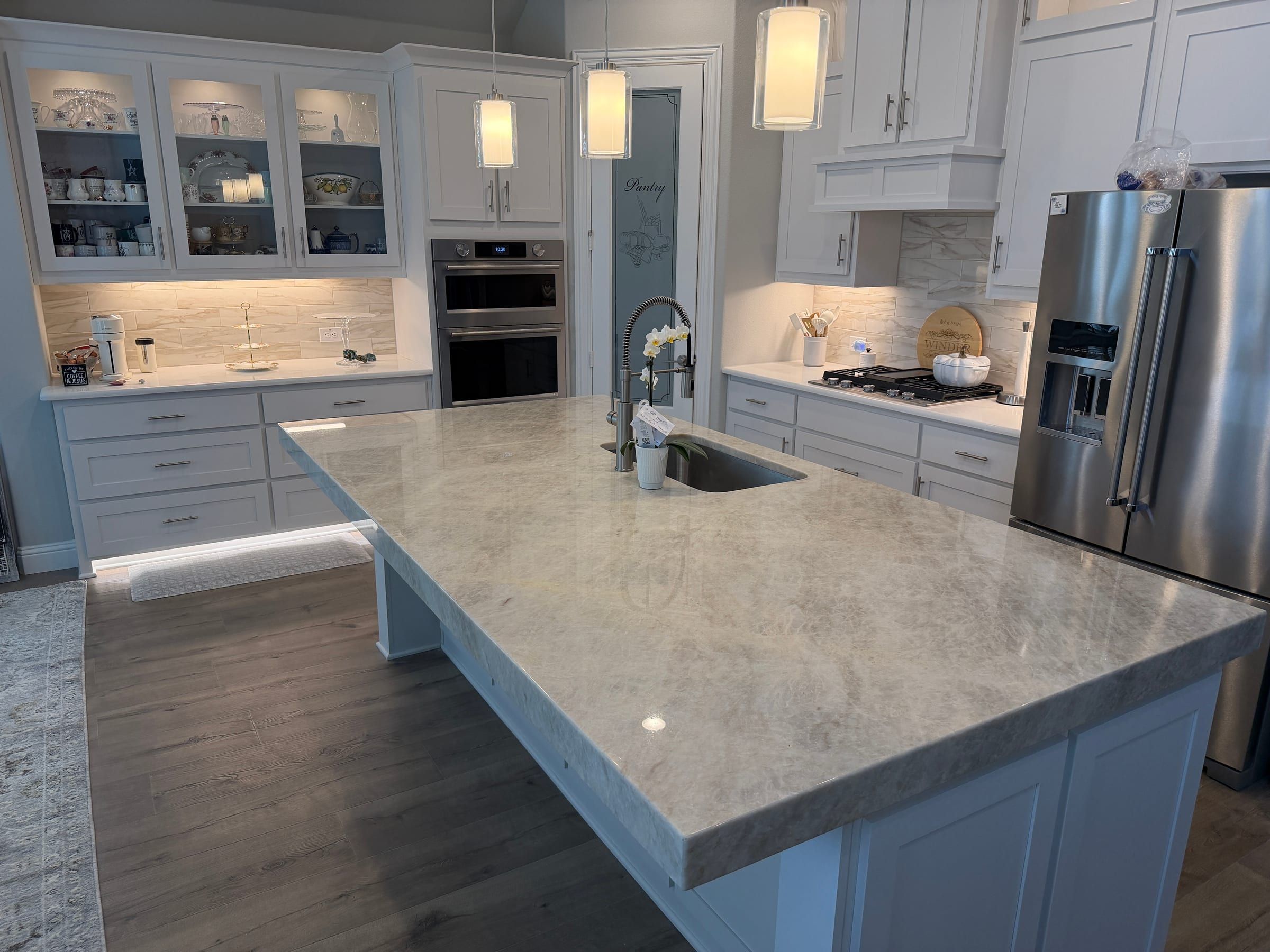
If you’ve been shopping for countertops in the Rockwall area, you’ve probably seen quartzite and quartz treated as the same thing. They share a name and can look nearly identical on a small showroom sample. Both contain the same mineral, which is the source of most of the confusion. This comparison clears it up.
Short answer: quartzite is a natural stone that handles heat well and resists scratches, but requires sealing. Quartz is an engineered countertop material with built-in stain resistance and no maintenance, but the resin that gives it those advantages is also what makes it vulnerable to a hot pan. Neither wins across every situation, and the right choice comes down to how the kitchen gets used.
| Category | Quartzite | Quartz |
|---|---|---|
| What it is | Natural metamorphic rock | Engineered stone (crushed quartz and resin) |
| Hardness | About 7 on the Mohs hardness scale | Slightly softer due to resin content |
| Heat resistant? | Yes, handles hot pans without damage | Resin scorches around 300°F |
| Sealing | Porous, reseal once or twice a year | Non-porous, never needs sealing |
| Pattern | Unique natural veining per slab | Consistent across production runs |
| Outdoor use | Fine if verified resin-free | Not suited for direct sun |
What Each Material Actually Is
Quartzite originates in its raw form as sandstone. That sandstone undergoes intense heat deep underground, fusing the grains under pressure until they compact and become tightly intergrown with each other. That interlocking structure is what makes quartzite so dense and hard.
Manufacturing quartz countertops is an entirely different process. The engineered nature of quartz comes from combining crushed natural quartz crystals with polymer resins under high pressure in a factory. Both materials carry the word “quartz” because both contain the same mineral. That’s the source of the confusion, and clearing it up early saves a lot of frustration at the showroom.
Natural Stone vs. Engineered Surface: Appearance and Design
Quartzite’s veining and color variations come from iron oxide and other minerals in the original sandstone deposit, giving slabs hues ranging from white and gray to soft pink and green, with some deposits producing deep red. The natural appearance of quartzite is genuinely one of a kind: no two slabs look exactly alike, which is why it’s chosen for statement kitchen islands.
Quartz is built for consistency across production runs so every slab matches. It can replicate the look of marble or even quartzite itself. For large kitchen countertops where an exact match across twelve or fifteen feet matters, that predictability is a real advantage. Stone Folks works with Cambria and Vicostone if you want to explore quartz options for your Rockwall project.
Hardness and Scratch Resistance
The Mohs hardness scale, developed by German geologist Friedrich Mohs, ranks minerals from 1 to 10 based on their resistance to scratching. A steel knife blade sits around 5.5 on that scale. The mineral quartz sits at 7, which is why quartzite, composed almost entirely of quartz, is one of the harder countertop materials you’ll find at a stone yard. It typically scores between 6 and 7, harder than granite in most cases.
Stone Folks’ Pat Folks works with quartzite regularly, and one thing that comes up fast: when our team cuts true quartzite in the shop, tooling wears faster than on softer stone, and that labor is built into the cost. Quartzite is highly scratch-resistant and an extremely durable surface for kitchen countertops. Quartz tests slightly softer due to its resin binder, though that flexibility does reduce corner chipping. Avoid abrasive cleaners on either surface, as they dull the finish over time.
Where Heat Resistance Differs Most
Quartzite is a heat-resistant countertop material by geological origin. Because it was formed under intense underground heat, it can withstand heat from a hot pot or cast iron skillet without damage under normal kitchen use, which is why it performs well near a range or in a fireplace surround. Quartz is a poor fit for both of those applications.
Quartz is more heat-sensitive than its hard surface suggests. Many manufacturers cite a thermal limit around 300°F where the resin begins to break down permanently, so trivets are essential. In direct sun, radiant heat pushes countertop surfaces well above ambient air temperature, making quartz a poor fit for outdoor kitchens in Fate or Royse City. Verify that any quartzite slab has no resin content before committing to that application.
Sealing and Stain Risk
As a porous material, quartzite stains if left unsealed. Quartzite requires sealing once or twice a year against mild kitchen acids, and with a fresh seal, it resists stains and acid etching where marble would show dull spots. Skip abrasive cleaners, since they break down the seal ahead of schedule.
Quartz has a non-porous surface with built-in stain resistance and no sealing required. Spills stay on top and wipe away, making it a straightforward choice for busy kitchens or families with kids. Our team carries several quartz brands and finishes at the shop, including Stone Folks’ granite and stone options if you want to compare side by side in person.
Cost Per Square Foot Installed
Quartzite’s density makes it harder to cut and template than engineered stone, and that labor shows up in the square foot installed price. The rarity of certain slabs pushes them equal to or above quartz, with heavily figured patterns at the high end.
Quartz ranges widely by brand and color. Get current numbers from your fabricator based on the actual slabs you’re considering. For smaller projects, ask us about stone remnants: leftover pieces from larger jobs sold at a significant discount.
The Fabricator’s Angle: Seams and Slab Layout
Every quartzite slab is unique, so a kitchen requiring multiple slabs needs careful seam planning. On higher-end projects, we bookmatch the veining so the pattern mirrors across the joint, and our team handles everything in-house from digital laser templating to the final seam polish.
Quartz makes seam work simpler because production-run slabs match so closely that seams disappear on long runs. Before committing to a large quartzite kitchen, ask your fabricator how they handle seam placement. Setting a six-hundred-pound slab with a suction rig teaches you quickly why placement can only happen once.
When to Choose Quartzite vs Quartz
If you’re still weighing all your countertop options for a DFW kitchen remodel, this table covers the most common decision points.
| Your situation | Better fit |
|---|---|
| Heavy cooking, hot pans off the stove regularly | Quartzite, or quartz with consistent trivet use |
| Zero maintenance, no sealing schedule | Quartz |
| A statement island with site-specific veining | Quartzite |
| Exact pattern match across a large kitchen | Quartz |
| Outdoor kitchen or full-sun countertop | Quartzite, verified resin-free |
| Bathroom vanities or bathroom countertops | Either works well |
Choose quartzite when the kitchen sees heavy cooking and real heat, or when the project calls for a surface with geological character that no engineered surface replicates. Plan for annual resealing.
Choose quartz when color consistency across a large kitchen is the priority, or when the household wants a popular countertop material that needs nothing beyond wiping down. Keep trivets accessible and avoid outdoor installs.
Buyer Beware: Confirm What You’re Actually Buying
Some slabs sold as quartzite, including “Fantasy Brown,” are actually softer dolomitic marble that etches when it contacts kitchen acids. Taj Mahal quartzite is a legitimate example of the real thing: a natural stone countertop with soft veining and genuine hardness. Stones that look similar may not share that mineral profile.
Ask your fabricator to confirm the actual hardness before purchasing. A reputable shop will test it, and that’s exactly the kind of conversation Pat built Stone Folks to have.
The Honest Takeaway
Quartzite brings real stone heat resistance and natural beauty that no engineered surface replicates, at the cost of periodic sealing and more involved installation. Quartz delivers consistent color and zero upkeep in return, with trivets as the one non-negotiable habit. The right choice comes down to how the kitchen gets used and how much maintenance you’re willing to take on.
Photos only go so far. Seeing the actual slab in your kitchen lighting, against your cabinets, changes how you evaluate it. Stone Folks is a veteran and family-owned countertop fabricator based in Rockwall. Pat Folks handles every project personally, and when clients are ready to look at full slabs, we take them through the wholesale slab yards in Dallas so they’re choosing from actual stone.
What Our Customers Say
⭐⭐⭐⭐⭐
Mitchell Salas
“Found this great company on the Rockwall chamber of commerce. My under mounted kitchen sink fell during the winter storm. I bought a kitchen sink and faucet at Costco and tried to get it in by myself but the quartz needed to be trimmed for the new top mount sink. I reached out and got an immediate response the evening of the sink falling. They contacted me next morning and had a team out to get it taken care of for us. I really appreciate the quick response and quality work. I will recommend Stone Folks in Rockwall to everyone.”
Call 214-980-2778 to talk through your project. If you’d rather start online, request a free estimate and Pat’s team will follow up directly. Military discount available, just ask when you reach out.
One scheduling note: we do not handle final plumbing reconnects. Plan for a licensed master plumber to reattach your sink lines the day after we install.