
How to Seal Granite Countertops (and How to Tell If Yours Even Needs It)
By Pat Folks
- countertops
- granite
- maintenance
- sealing
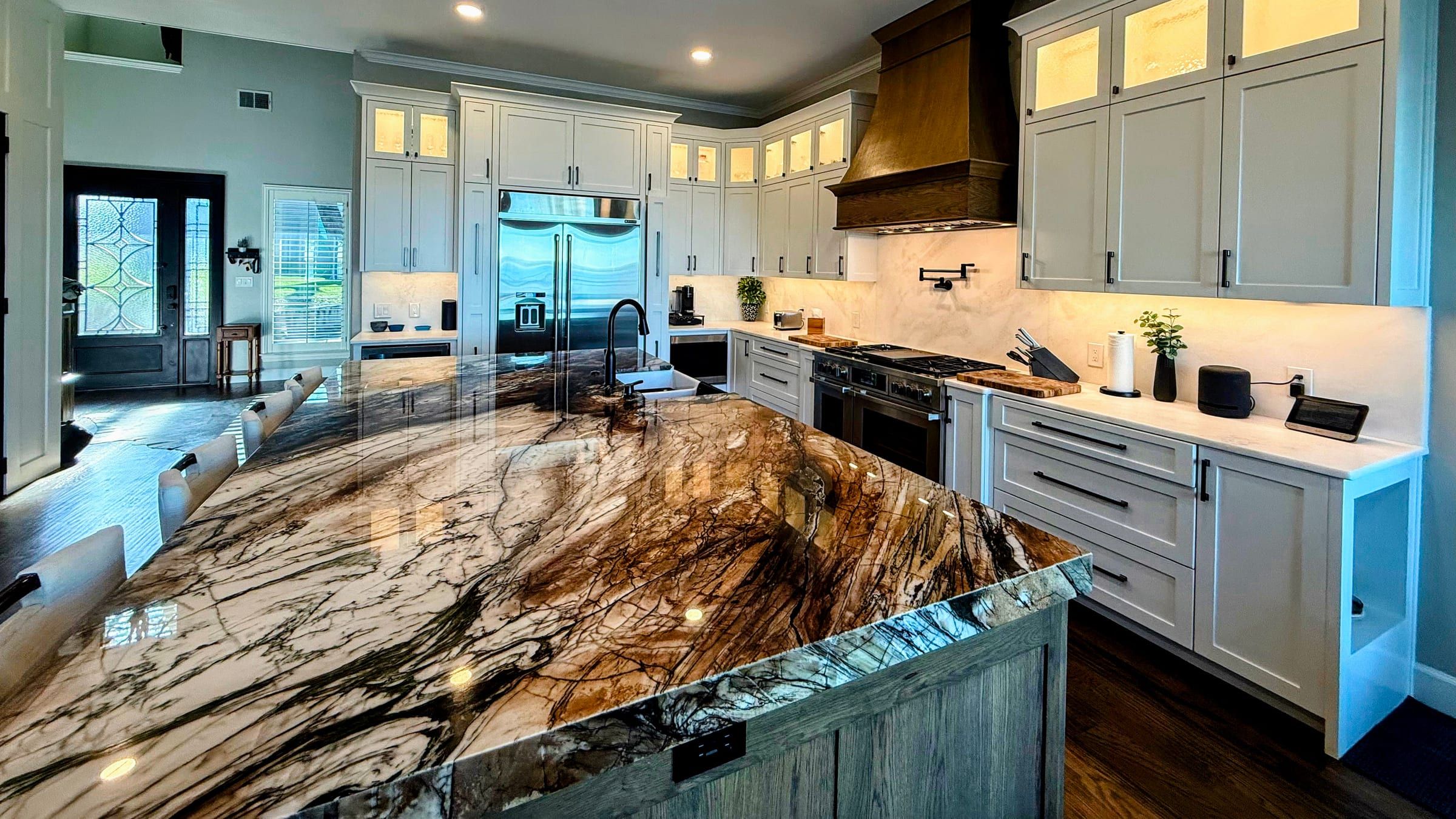
Not all granite countertops need sealing on the same schedule. A simple water test tells you whether yours needs it now, later, or not for years. It’s an easy way to get the real answer in under fifteen minutes.
Do Granite Countertops Need to Be Sealed?
Most do. But not all, and not on the same timeline.
Granite Is a Natural, Porous Stone
Granite forms from cooling magma and holds tiny pores between its mineral grains, gaps too small to see but big enough for liquid to sneak into.
Those pores let spills soak into the surface and leave dark spots behind. A penetrating sealer fills those gaps so a spill sits on top long enough for you to wipe it up before it sinks in, keeping the surface stain-resistant.
Granite has one of the lowest absorption rates of any common countertop material. A dense, well-polished slab can go years between coats. Testing your specific counter is the only reliable way to know, regardless of how old it is. If you’re weighing granite against the full range of options for a kitchen or bath rebuild, porosity is one of the first things worth understanding, since it drives how much upkeep a material needs.
The Water Test: Your Real Answer
Here’s the same test we walk clients through in their own kitchens.
Quick water test
- Clean a small section and make sure it’s completely dry.
- Place a few drops of water on the granite surface, away from the edge.
- Watch it for 10 to 15 minutes.
- Beads up or sits on top: the seal is still doing its job.
- Soaks in and darkens the stone: time to reseal.
For a second read, try a drop of lemon juice on an inconspicuous spot. A quick dark mark means the same thing. If you see a dull, permanently etched spot instead, that’s a different signal: the slab likely has some marble-like mineral blended in rather than being pure granite. Mention that when you call, so we know what we’re working with.
Test a few spots, especially near the sink and stove, where water and oil collect most. If one section soaks up water and another beads, seal the whole counter anyway.
Signs It’s Time to Reseal
Two signs matter between your yearly checks.
- Water stops beading and soaks in within a minute or two.
- Spills leave a darker patch that lingers after you clean it up.
Either one means the sealer has worn thin in that spot. Run the full water test before you commit to resealing.
How Often Should You Reseal Granite Countertops?
“Every six to twelve months” gets repeated everywhere online. That range fits some kitchens well. For plenty of others, it’s more sealing than the stone needs.
How often you reseal granite depends on the stone’s density and how heavily it’s used day to day.
| Granite type | Typical resealing interval |
|---|---|
| More porous, heavy daily use | Every 1 to 2 years |
| Dense, less permeable, lighter use | Every 3 to 5 years or longer |
A dense, low-porosity granite like Absolute Black rarely needs resealing at all, but the water test is still the only way to confirm that for your specific slab. Most homeowners land somewhere in the 1-to-5-year window once you account for both ends of the range.
Stone testers use ASTM C97 to measure this. The stone gets oven-dried, weighed, soaked for 48 hours, then weighed again, and the difference becomes the absorption value. Spec ranges under that test run from about 0.2 percent for marble up to 12 percent for low-density limestone, with granite typically landing on the low end. That’s the lab version of what your water test shows you at home.
What this means for your countertop: skip the calendar reminder. Run the water test once a year and let what you see determine the schedule.
How to Seal Granite Countertops, Step by Step
Once the test says go, the process itself is simple.
- Clean thoroughly a day ahead. Wipe the countertop with a pH-neutral cleaner about 24 hours before sealing. Skip vinegar or anything acidic; it can etch polished granite.
- Let it dry completely. This is the most important thing on this list. Trapped moisture blocks the sealer from soaking in and leaves a hazy film instead. Give it a few hours, longer if it’s a humid week.
- Work in small sections. Cover about 2 to 3 square feet at a time. Pour or spray a small amount from the bottle and spread it evenly with a clean cloth.
- Let it dwell. Most sealants need 15 to 20 minutes to soak in. Crack a window or run a fan if you’re using a solvent-based product.
- Wipe off the excess sealer before it hazes. Buff the surface with a dry microfiber cloth until it’s streak-free.
- Cure before use. Most sealers need 24 to 72 hours to fully cure. Keep the counter dry and unused during that window, and check the manufacturer’s label for the minimum wait before anything touches it.
There’s a particular smell that clings to your hands after an afternoon of sealing, that faint chemical tang that lingers no matter how many times you wash up. Small price for a counter that shrugs off red wine.
Most hardware stores, including Lowe’s, carry the tools this job calls for: a penetrating sealer and a couple of microfiber cloths. Penetrating sealers absorb into the stone itself, which is what keeps the surface looking like natural granite rather than something coated. Water-based formulas go on easier. Solvent-based ones reach deeper into the pores for best results.
Sealants built on a fluorocarbon aliphatic resin, a chemical family that repels both oil and water, tend to hold up longest, often 5 to 10 years, though lifespan varies by product, so check your specific sealer’s label. Other formulas run from 6 months to 3 years.
The bottom line on cost: a pricier fluorocarbon-based sealer usually costs less over time than reapplying a cheaper one every year. If you’re sealing a slab you paid good money to fabricate and install, it makes sense to use a product that won’t need revisiting until your kitchen sees another major update.
What Happens If You Don’t Seal Granite?
An unsealed, porous countertop lets spills work their way into the stone instead of sitting on top of it.
Oil, coffee, wine, and citrus are the usual culprits, and all of them should be wiped up right away.
Once a spill soaks in, the resulting stain can be tough to lift back out. Sealing buys you time to catch a spill before it turns into one you can’t wipe away.
Daily Care That Protects the Seal
Sealing lasts longer with a little regular maintenance behind it.
- Blot spills as they happen instead of wiping them around.
- Clean with mild dish soap and warm water, then dry with a soft cloth.
- Skip vinegar and other acidic cleaners. The sealer doesn’t fail all at once; it thins gradually, and the first sign is usually that water stops beading in the spots you clean most.
- Skip abrasive sponges and scouring pads, which dull the polished finish.
Quartz skips this whole question. As MSI explains , crushed quartz can make up as much as 93 percent of the slab, with a resin or cement-based binder and pigments filling in the rest. The mixture gets compressed under vacuum to push out air, which leaves nothing porous behind.
For anyone weighing materials for a new kitchen, we’ve put together a guide on keeping a quartz surface looking its best.
Rockwall sits right on Lake Ray Hubbard, and that keeps summer humidity higher than a lot of North Texas towns without a lake nearby. Cure and dry times tend to run toward the longer end of the ranges given in the steps above. Plan sealing a few days ahead of a big cookout or holiday to leave enough cure time.
Considering a New Countertop?
Granite still leads the U.S. countertop market, holding a 27.9 percent share in 2025, according to Grand View Research , more than any other single material.
Whether you’re maintaining granite you’ve had for years or weighing granite against other options for a new installation, test before you assume. Sealing a slab that’s already protecting itself just costs you an afternoon for nothing.
Quartz is worth a look too if it’s still in the running for your kitchen, and seeing how the two materials compare side by side makes that decision a lot easier.
Stone Folks has fabricated and installed countertops as a family-owned, veteran-owned shop for years, with a 5.0 rating across 31 reviews from homeowners in the area. We’ll take a complete look at your slab and tell you honestly whether it needs sealing now or can wait. Call us for a free estimate at 214-980-2778 and ask about our military discount.
⭐⭐⭐⭐⭐
“Guys this the place to go amazing service great teams excellent communication and spotless job. Many thanks to Larry and the rest of the team five stars is not enough 10 would make sense Thank You for being such great professionals”